Clovis’s lighthouse
The Reincarnationist PapersClovis’s lighthouse is a working beacon and a dwelling on a narrow point of land beside the Red Sea. The road ends at the tower, and Clovis lives in a small stone house built into its base. When Evan Michaels arrives, the lighthouse is not merely a remote landmark: it is a household, a workplace, and a mechanism whose nightly operation depends on deliberate, repeated labor.
Setting and Approach
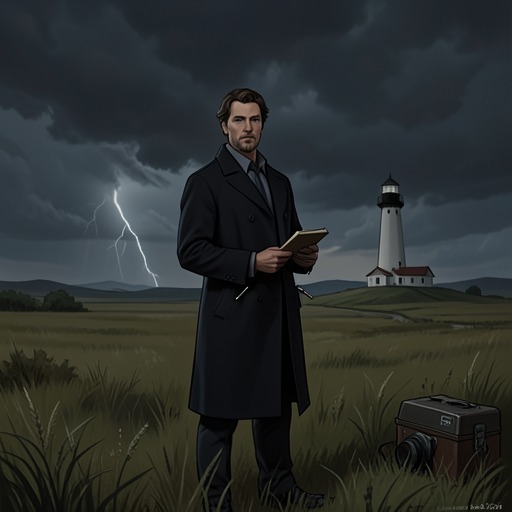
The lighthouse first appears from an isolated road beside the sea, its small spire rising from the sand against the ocean and sky. The journey gives the structure an almost solitary presence: Evan sees no other people, and the road itself seems to be the only sign that anyone has passed through the landscape. As the travelers draw near, the road winds down to a narrow projection of land, with the lighthouse’s stone blocks set between waves on either side. The changing evening light outlines the tower against the water, making it both a navigational structure and the destination of the journey.
The road does not continue beyond the lighthouse. Clovis explains that it stops there because the place is his home, though his living quarters occupy the base rather than the tower itself. A small stone house is dovetailed into the larger tan blocks, with a back door beside which a gray horse grazes on sparse grass. The arrangement joins domestic life to the lighthouse’s imposing masonry: the keeper does not commute to the beacon but lives within its structure, close to the work that keeps it operating.
Home and Daily Life
Inside, the house is made of roughly hewn stone, with large timbers supporting a thatched roof and an open hearth whose blackened edges record long use. A polished wooden table stands at the center of the room, accompanied by chairs; two additional chairs hang from a crossbeam above. When Clovis lights a brass lantern, he raises it toward the rafters with a rope, illuminating a room otherwise defined by sturdy, plain materials. He calls the arrangement a Yemeni chandelier. The practical ingenuity of the improvised fixture suits a dwelling where even light is something to be tended and positioned.
The home’s provisions depend on careful work in difficult ground. Clovis says that fresh loam has to be brought down from the highlands each winter, and that he keeps a garden between the lighthouse and a well on the hill. Evan later sees the enclosed plot, its darker fertile earth held within roughly hewn stones while fine sediment has drifted over the border. Green and withered stalks move in the breeze. The well is a deep, stone-circled hole, and drawing water means raising a porous, rotting bucket on a thin rope before filling a leather bladder. The garden and well make the lighthouse more than an outpost: they show the daily arrangements that sustain life there, while also exposing how little the land supplies without effort.
The Lighthouse at Work
The tower’s light is a clock-driven system, not a static flame. From the house, Evan hears a sudden, sustained mechanical clatter and fears that the tower has collapsed into the sea. Clovis recognizes the sound as Drusel resetting the light’s pendulum weights. Drusel, the younger brother of Nusel, has been keeping the beacon during Clovis’s absence. The revolving lens is powered by a large clock mechanism that must be wound each night to keep it going until morning. The noise that startles Evan is thus a sign of routine maintenance and of another person’s work continuing while the keeper is away.
Clovis later takes Evan up the circular stone stairs built into the tower wall. Two heavy black chains hang through the center of the spiraling ascent, which ends at the narrow catwalk Evan had seen from outside. Above it, window panes enclose the clear, beehive-shaped lens. Clovis opens the glass framework, reaches the small hinged door over the soot-marked brass burner, and wipes fine black powder from the lens with a rag. He then has Evan bring him a bottle of yellow oil. These tasks—cleaning, supplying fuel, lighting the burner, and setting the mechanism in motion—make the beacon’s operation depend on close attention to both flame and machinery.
Before Evan lights the burner, Clovis warns him not to look at the light and directs him toward the sea-facing railing. He turns a large crank; the familiar mechanical clatter begins, and the two stand at the railing as the beam sweeps across the darkness every ten seconds. The sequence connects the house’s lantern, the tower’s clockwork, and the light’s outward reach: illumination here is produced through specific acts of care, then sent beyond the isolated home. The scene also makes the work visible to Evan, who has arrived as a guest and is invited to see how the lighthouse functions rather than simply observe its distant glow.
Clovis’s Home and Its Significance
The lighthouse gathers several kinds of dependence into one small place. The tower requires nightly winding and tending; the house relies on a garden fed with imported soil and water drawn from a rough well; and during Clovis’s absence Drusel takes responsibility for the light. Its remoteness is therefore not emptiness. The apparently solitary spire stands within a modest network of labor, supplies, and human care, even as the road ends at its door and the sea encloses the point of land.
For Evan, the place becomes an inhabited interior after first appearing as a distant silhouette. He enters through the house’s wooden door, sees its lantern and hearth, encounters the practical limits of its soil and water, and then climbs into the working tower. That progression—from landscape, to home, to mechanism—defines the lighthouse’s role in the episode. It is at once shelter and responsibility: Clovis’s home is inseparable from keeping the light burning through the night.